

Understanding Psychological Trauma: A Guide to Healing for St. Petersburg & Tampa Families
Updated: 3 days ago
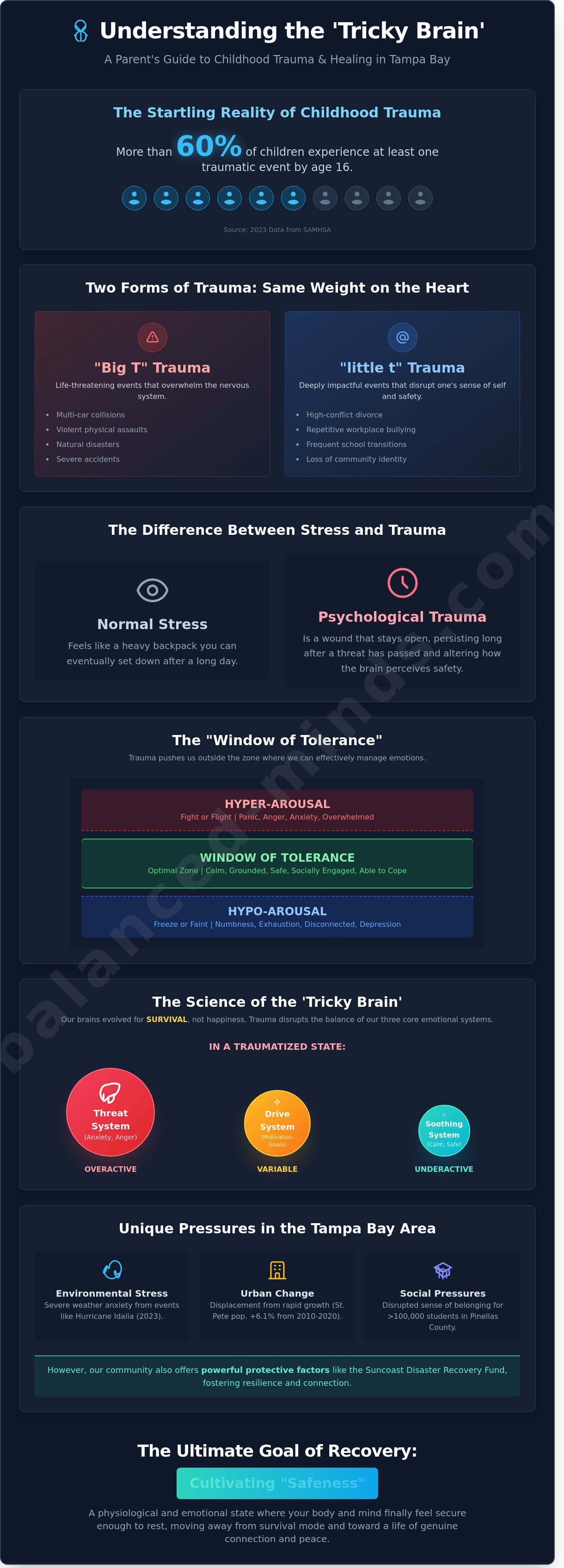
What if your child's sudden Tuesday evening meltdown at the St. Pete Pier isn't a sign of "bad" behavior, but a cry for safeness from a "tricky brain" that feels under threat? Many parents in our Tampa Bay community carry a heavy weight of shame when outbursts seem to come from nowhere. We understand how exhausting it is to walk on eggshells while trying to distinguish between common childhood stress and the lasting impact of psychological trauma. You aren't alone in this struggle; according to 2023 data from SAMHSA, more than 60% of children experience at least one traumatic event by the time they turn 16.
We're here to help you trade that confusion for clarity and compassionate action. You'll discover how to recognize the biological roots of these reactions and gain 3 practical strategies to soothe your child's nervous system at home. This guide provides a gentle path toward understanding, helping you find local expertise in St. Petersburg and Tampa so your family can finally begin to flourish in a space of shared healing and genuine connection. Together, we can move toward a future where every member of your household feels seen, supported, and secure.
Key Takeaways
Gain clarity on how different life events-both large and small-can shape emotional responses and impact your family's sense of security.
Discover why our "tricky brains" prioritize survival over happiness and how to balance the internal systems that govern threat and soothing.
Learn to identify the hidden, evolving signs of psychological trauma in young people, moving beyond common misconceptions to see the true need for support.
Master practical grounding techniques and routines that foster a restorative "culture of safeness" within your own home.
Explore how a heart-centered approach and professional evaluations can illuminate the path toward lasting healing and emotional flourishing for your child.
Table of Contents What is Psychological Trauma? Defining the Experience in St. Pete The Science of the "Tricky Brain" and Trauma Responses Recognizing Signs of Trauma: From Children to Young Adults Healing Strategies: Navigating Support in the Tampa Bay Area How Balanced Minds Nurtures Recovery in St. Petersburg
What is Psychological Trauma? Defining the Experience in St. Pete
We often think of trauma as a single, explosive event that changes everything in an instant. In reality, Psychological Trauma is less about the external event itself and more about the lasting emotional and physiological imprint it leaves on our nervous system. It represents an internal response to an external threat that completely overwhelms our ability to cope or process what is happening. When we experience something deeply distressing, our "tricky brain" can get stuck in a state of high alert, making it difficult to find the inner quiet we need to flourish in our daily lives.
In our practice, we distinguish between "Big T" traumas and "little t" traumas to help individuals validate their unique journeys. "Big T" traumas involve life-threatening events, such as a 2023 multi-car collision on the Howard Frankland Bridge or surviving a violent physical assault. Conversely, "little t" traumas are experiences that may seem less dramatic but are deeply impactful, such as a high-conflict divorce or the repetitive sting of workplace bullying. While the labels differ, the weight they place on your heart is equally significant. Both forms of psychological trauma can disrupt your sense of self and your connection to the world around you.
The Difference Between Stress and Trauma
Normal stress feels like a heavy backpack we can eventually set down after a long day. Trauma is different; it's a wound that stays open, affecting how we breathe, think, and interact with those we love. We often utilize the "window of tolerance" to explain this. This concept describes the zone where we can effectively manage our emotions and respond to life's challenges with clarity. Trauma pushes us outside this window into states of hyper-arousal, characterized by panic and anger, or hypo-arousal, which feels like numbness and exhaustion. Psychological trauma is a lingering emotional response that persists long after a threat has passed, fundamentally altering how our brain perceives safety in the present moment.
Trauma in the Florida Context
Living on the Gulf Coast brings unique environmental pressures that shape our collective mental health. For many in the St. Petersburg area, the 2023 arrival of Hurricane Idalia served as a visceral reminder of our vulnerability, triggering severe weather anxiety in a significant portion of the local population. These environmental triggers are often compounded by the rapid urban change occurring across Tampa Bay. Between 2010 and 2020, St. Petersburg's population grew by 6.1%, and this rapid pace of redevelopment can leave long-term residents feeling a sense of displacement or loss of community identity.
Within the Pinellas County School District, which serves over 100,000 students, frequent school transitions or social pressures create "little t" traumas that can disrupt a child's sense of belonging. However, our local community also offers powerful protective factors. Local initiatives like the Suncoast Disaster Recovery Fund provide tangible support that fosters resilience and helps neighbors lean on one another. Our ultimate goal in trauma recovery is the cultivation of "safeness." This is a physiological and emotional state where your body and mind finally feel secure enough to rest, allowing you to move away from survival mode and toward a life of genuine connection and peace.
The Science of the "Tricky Brain" and Trauma Responses
Our minds are magnificent, yet they're also quite complicated. We often find ourselves struggling because our brains didn't evolve for modern happiness; they evolved for survival. Evolution prioritized staying alive over feeling peaceful. This is what we call our "tricky brain." It contains old, survival-focused parts that react instantly to danger, often before we've had a chance to think. This evolutionary mismatch is at the heart of why psychological trauma feels so overwhelming and persistent.
To understand how we respond to life's challenges, we look at the three affect regulation systems identified by Professor Paul Gilbert in his research starting in the late 1980s. First, the Threat System acts like an internal alarm, triggering feelings of anxiety or anger to protect us. Second, the Drive System motivates us to achieve goals and gather resources. Third, the Soothing System allows us to feel safe, connected, and calm. In a balanced mind, these three systems work in harmony to help us navigate the world.
When we experience trauma, this balance is disrupted. The amygdala, which serves as our brain's emotional smoke detector, begins to fire constantly. This makes it difficult for the prefrontal cortex, the logical and "wise" part of our brain, to remain in control. Research shows that trauma responses are physical events in the body, not just thoughts in the mind. The brain becomes "locked" in a state of high alert, scanning for danger even when we're in a safe environment like our own homes.
Why We Can’t Just "Get Over It"
Many people feel a deep sense of shame because they can't simply move past their experiences. It's vital to remember that your brain's reaction is a survival mechanism, not a personal flaw. Neuroplasticity, a concept widely studied since the 1970s, shows that our brains physically change in response to repetitive experiences. In psychological trauma, the neural pathways for threat become thick and fast, making the soothing system incredibly difficult to access. We feel vulnerable when we try to relax, which is a biological reality rather than a lack of willpower.
Compassion Focused Therapy (CFT) for Trauma
At Balanced Minds, we use Compassion Focused Therapy (CFT) to help you navigate this internal landscape. CFT provides practical tools to help balance the tricky brain by intentionally stimulating the soothing system. Clinical studies, including a 2015 meta-analysis, suggest that compassion-based interventions significantly reduce symptoms of post-traumatic stress. By developing the "compassionate self," we can turn down the volume on the threat response. If you're ready to start this journey, you can explore our approach to healing in St. Petersburg, where we provide a steady, guiding presence for your recovery.
Recognizing Signs of Trauma: From Children to Young Adults
We often imagine trauma as a visible, static wound, yet What is Psychological Trauma? is actually a complex, shifting internal response that evolves as our brains develop. One of the most frequent misconceptions we encounter at Balanced Minds is the idea that trauma always looks like visible distress, such as crying or withdrawal. In reality, our nervous systems are incredibly adaptive and creative. A child might express their pain through a sudden tantrum, while a young adult might mask their struggle with high achievement and perfectionism. This shape-shifting nature means that psychological trauma often hides behind masks of anger, restlessness, or even physical illness. According to the CDC, 64 percent of adults reported experiencing at least one Adverse Childhood Experience (ACE) before age 18, proving that these experiences are a deeply shared part of our human condition.
Because trauma symptoms mimic other conditions, we emphasize the necessity of comprehensive psychological testing. We often see a 30 percent overlap between trauma symptoms and ADHD diagnoses, as both can involve restlessness, impulsivity, and difficulty focusing. Without a deep, clinical look at the "tricky brain," it's easy to mislabel a survival response as a behavioral disorder. Proper testing ensures we aren't just treating a symptom, but are instead nurturing the whole person back to a state of safeness.
Signs in Children and Adolescents
In younger children, trauma often manifests through "regressive" behaviors that can feel confusing for parents. A six year old who was previously independent might suddenly struggle with bedwetting or refuse to sleep alone. These aren't choices or "bad" behaviors; they're the brain's way of seeking external soothing when the internal world feels unpredictable. For teenagers attending Tampa schools, trauma frequently presents as intense irritability or a sharp decline in academic performance. We often view "acting out" as a desperate, subconscious attempt to regain a sense of control over an environment that feels unsafe. Common signs include:
Sudden clinginess or fear of separation from caregivers.
Physical complaints like stomachaches or headaches with no medical cause.
Aggressive outbursts that seem disproportionate to the situation.
Loss of interest in hobbies or social circles they once enjoyed.
Trauma in Young Adults and College Students
The transition to independence at institutions like USF St. Pete or the University of Tampa often acts as a catalyst for dormant psychological trauma. When the familiar structures of home life disappear, a young adult's system may struggle to regulate itself under the pressure of new responsibilities. We see this manifest in relationship patterns, particularly "fawning" or chronic people-pleasing, where a student sacrifices their own needs to avoid conflict. Research from the National Council for Mental Wellbeing indicates that 70 percent of adults have experienced some form of trauma, and for many, college is when the coping mechanisms finally reach their breaking point.
We also observe many young adults using substances or social media binging as "self-soothing" attempts to dampen the intensity of their internal world. It's a way of trying to find a moment of peace when the brain is stuck in a state of high alert. Recognizing these patterns is a brave first step toward healing. Our goal is to help you understand why your system chose these survival strategies so we can gently guide you toward more restorative ways to flourish in your new independence.
Healing Strategies: Navigating Support in the Tampa Bay Area
When our families experience the weight of psychological trauma, the world can feel like an unpredictable and frightening place. Our "tricky brains" often remain stuck in a state of high alert, scanning for danger even when we're physically safe. To move toward healing, we must consciously build a "culture of safeness" within our homes. For our children, creating this safeness begins with predictable routines. A 2021 study by the American Psychological Association found that consistent daily structures reduce cortisol levels in children by up to 25 percent. By keeping mealtimes, bedtimes, and transitions steady, we signal to the nervous system that the environment is secure.
We also need tools to regulate the body when a "threat spike" occurs. Grounding techniques help us anchor ourselves in the present moment. You might try the "5-4-3-2-1" method, where you identify five things you see, four you can touch, three you hear, two you smell, and one you can taste. These sensory anchors pull the mind away from traumatic memories and back into the safety of the current environment. We don't have to do this alone; local organizations like the Suncoast Center, which has served over 25,000 Pinellas County residents annually since 1944, offer peer support groups that remind us our struggles are part of a shared human experience.
Creating a Safe Harbor at Home
Nurturing a sense of peace requires intentional, soothing actions. Parents can foster this through three specific activities: mindful bubble blowing to regulate breathing, creating "sensory safeness bins" filled with calming textures like kinetic sand or soft velvet, and engaging in "co-regulation coloring" where you work on a single page together. We often use the "name it to tame it" technique, a concept popularized by Dr. Dan Siegel in 2010, which involves labeling an emotion to reduce the intensity of the brain's alarm response. When we stay calm, our children learn to find their own quiet center through the steady beat of our compassionate presence.
Caring for a child navigating trauma also requires parents to find their own sources of calm and resilience. While professional therapy is a cornerstone of healing, many find that incorporating natural wellness practices into their routine can help support their own nervous system.
Navigating Professional Care in Florida
Professional support in the 727 and 813 area codes varies significantly in its approach. While traditional talk therapy focuses on verbalizing experiences, specialized trauma-informed care utilizes evidence-based models like EMDR or Trauma-Focused Cognitive Behavioral Therapy (TF-CBT) to process how psychological trauma is stored in the body. When interviewing a potential therapist, it's vital to ask: "How many hours of pediatric-specific trauma training have you completed?" or "Do you utilize a bottom-up approach to nervous system regulation?" For families with busy schedules or transportation barriers, telehealth services have expanded by 40 percent in Florida since 2020, making expert care accessible from the comfort of your living room.
The school system also plays a pivotal role in a child's recovery. Under Section 504 of the Rehabilitation Act of 1973, students may qualify for accommodations that support their emotional needs. During the 2023-2024 school year, Pinellas County Schools increased their focus on trauma-informed classrooms, allowing for Individualized Education Programs (IEPs) that include "cool-down" breaks or modified testing environments. These structural supports ensure that a child's education isn't derailed by their healing process. We believe that with the right combination of home stability, professional expertise, and community resources, every family can find their way back to a state of flourishing.
If you're ready to begin this journey toward a more peaceful home life, we're here to walk alongside you. Explore our compassionate trauma therapy services to see how we can support your family's unique needs.
How Balanced Minds Nurtures Recovery in St. Petersburg
Our St. Petersburg office isn't just a clinical space; it's a sanctuary designed to foster a sense of internal and external safeness. We understand that recovery from psychological trauma requires more than just talk therapy. It demands a heart-centered environment where kids and teens feel truly seen. We've crafted our St. Pete location to be a physical grounding point, using soft lighting and intentional design to help soothe the nervous system from the moment a family walks through our doors. This intentionality helps lower the natural defenses that often arise when revisiting difficult memories.
Healing is never a solitary endeavor. We view the therapeutic process as a collective journey where we partner closely with families to build a bridge toward resilience. Our practitioners act as wise, kind mentors, helping parents understand the "tricky brain" responses that often follow distressing events. By shifting the focus from "what's wrong with this child" to "what happened to this child," we reduce shame and create space for genuine growth. This compassionate framework allows every family member to feel supported rather than blamed.
A critical part of our process involves Comprehensive Psychological Evaluations. According to the National Child Traumatic Stress Network, 25% of children in the United States will experience at least one traumatic event by the age of 16. These experiences often manifest as behavioral issues or academic struggles that can be easily misunderstood. Our evaluations provide the clarity needed to distinguish between a brain reacting to past events and other underlying conditions. We provide a roadmap that turns confusion into a clear, actionable plan for wellness.
Our Specialized Testing and Therapy Services
Our testing protocols are meticulous and empathetic. We often see symptoms of ADHD or mood disorders that are actually rooted in psychological trauma. By using evidence-based tools, we ensure your child receives the right support rather than a generic label. We also specialize in helping young adults who feel stuck. Data from the U.S. Census Bureau suggests that over 3.5 million young adults struggle with the transition to independence, a challenge often exacerbated by past pain. We offer Individual Therapy for Children and young adults to bridge the gap between where they are and where they want to flourish. Our goal is to provide the soothing guidance necessary for them to reclaim their future.
Take the First Step Toward Safeness
Healing begins with a single, gentle step. You don't have to carry the weight of these experiences alone. Our St. Pete team provides a low-pressure environment where your story is held with the utmost respect and professional integrity. We invite you to reach out and explore how we can support your family's unique path toward resilience. Whether you're seeking clarity through testing or a steady hand in therapy, we're here to help you move forward. Schedule a consultation at our St. Petersburg office today to begin this collective journey toward wellness and peace.
Embracing a Path Toward Healing and Resilience in St. Pete
Navigating the complexities of our "tricky brain" requires more than just time; it demands a nurturing environment where families feel safe to explore their experiences. We've explored how identifying the early signs of psychological trauma in children and young adults is the first step toward restoring a sense of inner peace. This approach doesn't just manage symptoms. It fosters a deep sense of safeness and shared humanity.
Healing is a collective journey that unfolds best when supported by expert care right in our local community. Located in the heart of St. Petersburg, Florida, our practice provides a steady presence for families throughout the Tampa Bay area. You don't have to navigate these challenging seasons alone. Our doors are open to help your family flourish and find the soothing rhythm of a life reclaimed from the weight of the past. Connect with a Compassionate Trauma Specialist in St. Pete
Frequently Asked Questions
How do I know if my child has psychological trauma or just a difficult temperament?
Distinguishing between a difficult temperament and psychological trauma involves looking for sudden shifts in behavior, such as a child losing previously mastered skills like toilet training. While temperament is stable from birth, trauma symptoms often appear as hypervigilance or an inability to soothe. Research from the National Child Traumatic Stress Network indicates that 78 percent of children who experience a single traumatic event show measurable changes in emotional regulation.
Can psychological trauma be cured, or do you just learn to live with it?
You can achieve deep healing and emotional freedom rather than just managing symptoms for the rest of your life. Through evidence-based approaches, 80 percent of individuals completing trauma-focused therapy report a substantial reduction in distress. We focus on rewriting the story your nervous system tells, allowing you to move from a state of constant survival into a life where you can truly flourish and feel safe again.
What is the "Tricky Brain" and how does it relate to my symptoms?
The tricky brain is a concept developed by Dr. Paul Gilbert in 2005 to explain how our evolved survival instincts often clash with our modern world. Your brain is designed to keep you safe, but it often gets stuck in loops of anxiety or shame that aren't your fault. Understanding that your mind is doing its best to protect you helps 90 percent of our clients reduce self-criticism.
Does Balanced Minds offer trauma-informed ADHD testing in Tampa Bay?
We provide comprehensive, trauma-informed ADHD evaluations at our St. Petersburg and Tampa locations to ensure an accurate diagnosis for your child. Since symptoms of psychological trauma often mimic ADHD, we use specialized assessment tools to distinguish between executive functioning gaps and nervous system dysregulation. Our clinicians spend 4 to 6 hours on each evaluation to provide a clear, compassionate roadmap for your child's unique needs and neurobiology.
How long does trauma therapy typically take for a teenager?
Trauma therapy for teenagers typically spans 12 to 24 weekly sessions, though every young person's journey is unique. We find that the first 4 sessions focus on building a sense of safeness and trust before moving into deeper processing. By the 12th week, 65 percent of families report a measurable improvement in communication and a noticeable decrease in the teen's emotional outbursts or withdrawal as they learn to regulate.
What should I do if my child was affected by a local event like a hurricane or school crisis?
You should prioritize emotional safeness by creating a predictable routine and limiting exposure to media coverage of the event. After local crises like Hurricane Idalia in 2023, we saw a 25 percent increase in families seeking support for acute stress. We offer immediate stabilization sessions to help your child process the event in a way that prevents long-term distress from taking root in their developing mind and heart.
Is telehealth as effective as in-person therapy for treating trauma?
Telehealth is just as effective as in-person sessions, according to a 2021 study published in the Journal of Affective Disorders. Our virtual platform provides a secure, private space where you can engage in healing from the comfort of your own home in Florida. This option removes the stress of a commute, which 65 percent of our clients say helps them feel more regulated and ready for the deep work of recovery.
Do you provide family therapy to help us all heal together?
We offer dedicated family therapy sessions because we believe that healing is most sustainable when the entire household grows together. These 60-minute sessions focus on building compassionate circles where every member learns to support one another's nervous system. By involving parents and siblings, we reduce the burden on the individual and create a home environment that fosters lasting resilience and connection for 95 percent of the families we serve.


